
Academic Accrediation
Roles and Responsibilities of Academic Accreditation:
1.Academic Quality Management and Accreditation
To coordinate programme audits under accreditation as well as ensuring the continuous maintenance of the university’s accreditation status.
2.Programme Recognition in the Malaysian Qualifications Register (MQR)
To manage the registration of academic programmes in the Malaysian Qualifications Register (MQR), ensuring compliance with the Malaysian Qualifications Framework (MQF) and related guidelines issued by the Malaysian Qualifications Agency (MQA).
Quality Assurance
Roles and Responsibilities of Quality Assurance:
1.Quality Management System
To manage and coordinate ISO certification processes at AIU through the implementation of the Educational Management System (EOMS – ISO 21001) and Integrated Management System (Iso 9001, 14001 and 45001) to ensure consistent and effective service delivery.
2.Service Quality Recognition
To coordinate and manage recognition initiatives for quality services, by promote innovation and excellence in AIU’s service delivery.
The Centre for Quality Assurance and Accreditation (CQAA) at Albukhary International University (AIU) comprises two (2) main units: Academic Accreditation Unit and Quality Assurance Unit.
Quality Accreditation Unit
Roles and Responsibilities
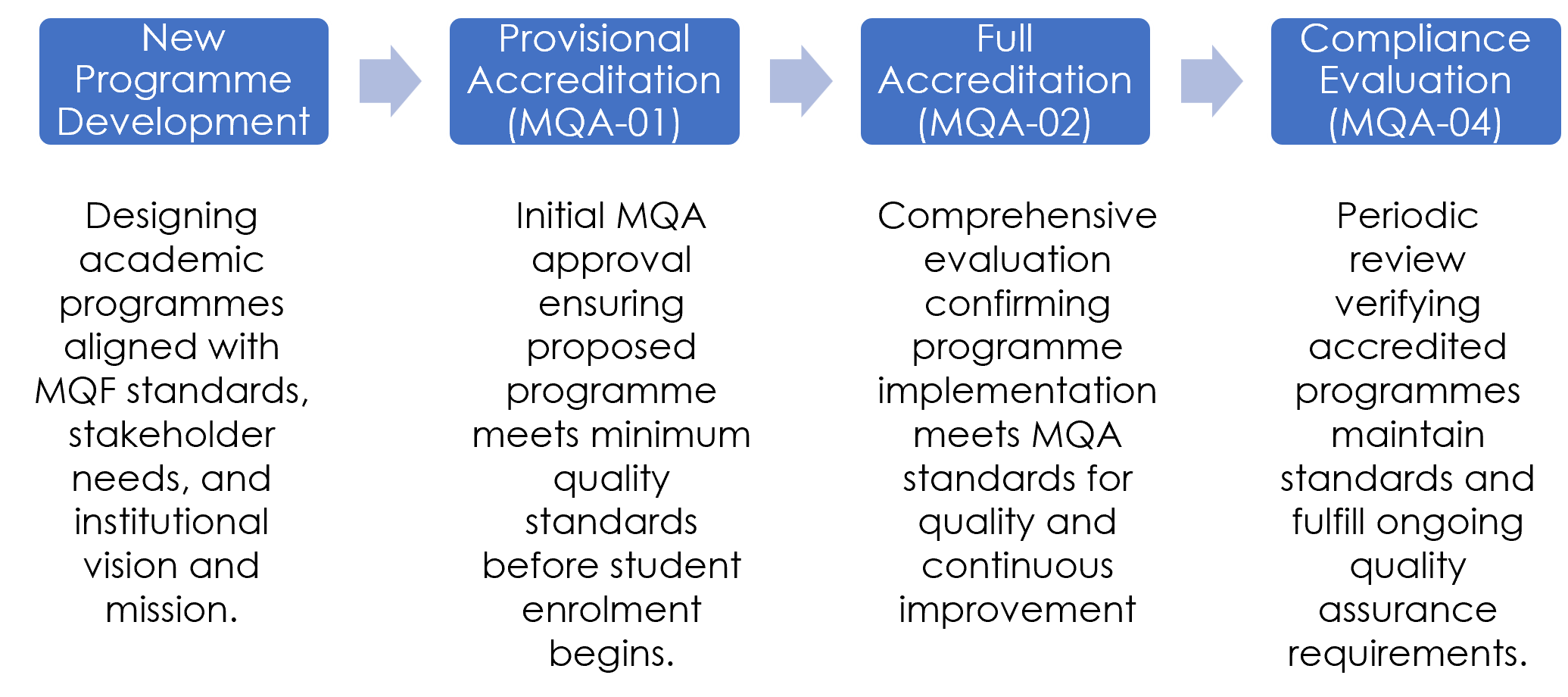
The Quality Accreditation Unit ensures that all academic quality initiatives are aligned with the University’s strategic goals by overseeing the implementation of quality assurance policies, reviewing new and revised programme proposals for compliance with MQF and MQA standards, and monitoring regulatory requirements and assessment practices. It coordinates programme audits under accreditation requirements, conducts internal and external reviews, manages accreditation submissions, and ensures the University’s accreditation status is continuously maintained through effective follow-up and closure of CAPA.
The Unit also manages the registration of all academic programmes in the Malaysian Qualifications Register (MQR), ensuring compliance with MQF and MQA guidelines and keeping programme information updated. In addition, it builds awareness of accreditation and quality processes across the University, engages with MQA and professional bodies, updates the academic quality framework in line with national and international benchmarks, and communicates findings, recommendations, and lessons learned to leadership and stakeholders to support continuous improvement.
Academic Accreditation Committee
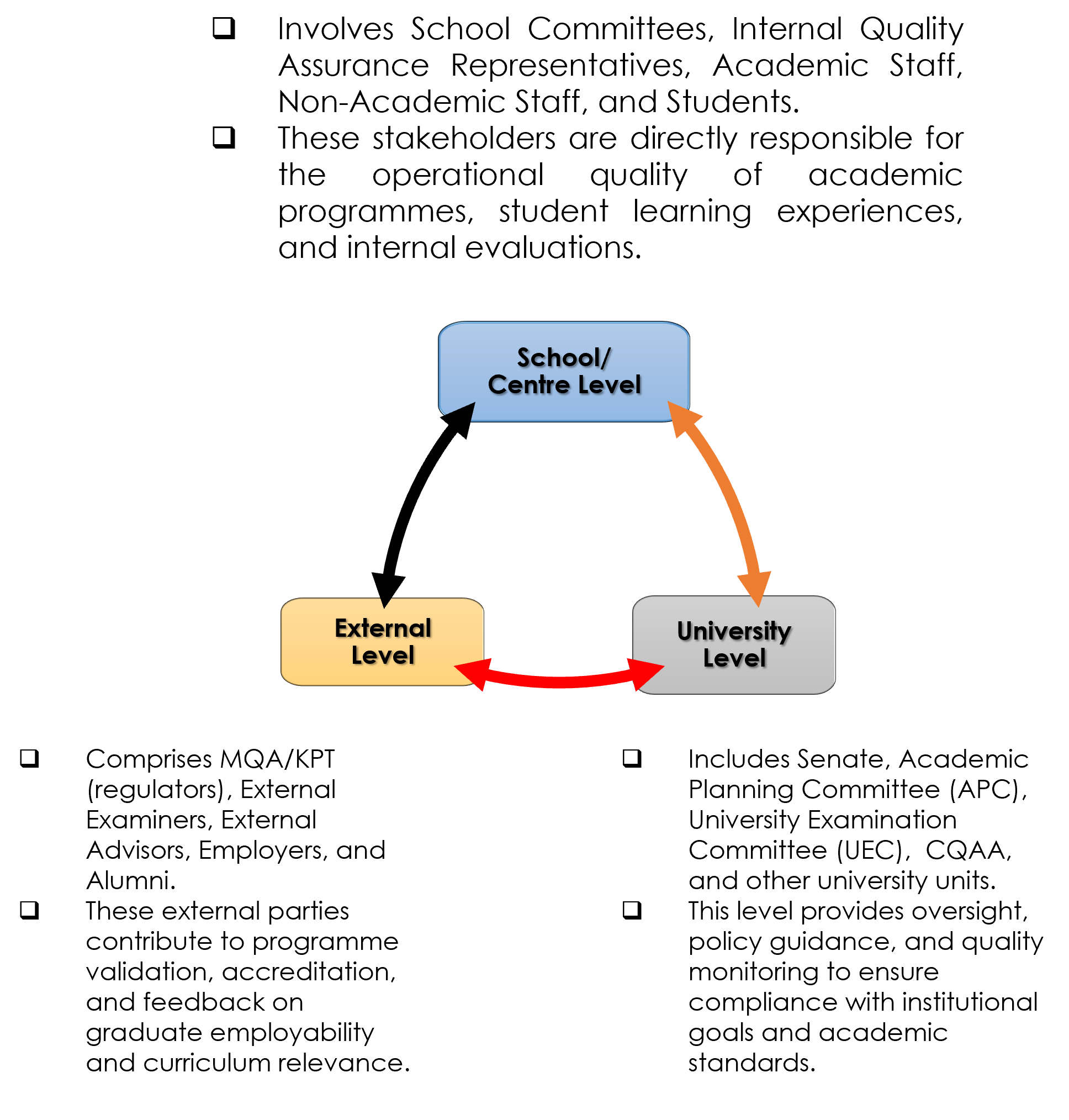
INTEGRAL LINK

Quality Assurance Unit
Quality Management System
Roles and Responsibilities
The Quality Assurance Unit defines and communicates the University’s ISO strategy and objectives in alignment with the Strategic Plan, provides governance and oversight to integrate ISO standards into all operations, and endorses policies, manuals, and procedures to ensure their consistent application. It monitors compliance with ISO requirements through internal audits, external certification audits, and management reviews, reviews nonconformities (NCRs), Areas of Concern (AoCs), and Corrective and Preventive Actions (CAPA), and ensures their closure while also evaluating performance indicators to drive continual improvement across the University.
The Unit builds awareness and ownership of ISO practices within the University community, provides training, workshops, and communication strategies to strengthen institutional capacity, and engages with regulators, accreditation bodies, and partners to align with global quality practices. It promotes innovation and best practices by benchmarking against national and international standards, ensures that ISO standards, policies, and practices are reviewed and updated regularly, and embeds lessons learned from audits, reviews, and risk events into planning and future improvement.
ISO CERTIFICATION
Albukhary International University (AIU) is certified to ISO 21001:2018 (Educational Organisations Management System). This certification strengthens AIU’s commitment to delivering high-quality education aligned with international standards, with a strong focus on effective academic processes, learner satisfaction, and continual improvement.
Note: AIU is ISO 21001:2018 certified by Bureau Veritas – 31 December 2025
Looking ahead, CQAA will initiate the Integrated Management System (IMS) certification process in 2026, covering:
- ISO 9001:2015 – Quality Management System
- ISO 14001:2015 – Environmental Management System
- ISO 45001:2018 – Occupational Health and Safety Management System
This phased approach aims to establish a comprehensive and unified management framework, ensuring excellence in academic quality, service delivery, environmental sustainability, and occupational health and safety practices across the university.
Through these initiatives, CQAA reinforces AIU’s vision of becoming a globally recognized institution of higher learning that upholds the highest standards of quality, sustainability, and stakeholder trust.
EOMS SCOPE
1. Design, development, and delivery of tertiary education programmes at foundation, undergraduate, and postgraduate levels.
2. Provision of academic support services to learners.
The scope of AIU’s EOMS encompasses:
- The design, development, delivery, and continual improvement of all tertiary education programs offered at diploma, undergraduate, and postgraduate levels.
- Research activities and community engagement initiatives that contribute to educational enhancement.
- Student services, including support for academic advising, counselling, career services, and welfare programs.
AIU EOMS Objectives:
AIU Educational Objectives (EOMS Objectives). At AIU, the Educational Objectives are anchored in five (5) Strategic Pillars which guide institutional direction and priorities. These pillars are directly mapped from the AIU Strategic Plan 2025–2030 to ensure full alignment between educational aspirations and the University’s long-term vision and mission.
The Five Strategic Pillars are:
a) Academic Excellence and Accreditation – Delivering high-quality programmes with full compliance to accreditation and international benchmarks.
b) Student Experience and Graduate Employability – Enhancing learner-centred experiences, engagement, and employability outcomes.
c) Research, Innovation, and Social Impact – Strengthening research contributions, innovation capacity, and community/ industry partnerships.
d) Digital Transformation and Learning Innovation – Expanding access through technology-enabled learning and smart campus initiatives.
e) Governance, Sustainability, and Institutional Culture – Building a strong culture of integrity, inclusiveness, safety, and environmental responsibility.